Every Season, Growers Are Spending Money They'll Never See Again
You’ve done everything right. You’ve scouted your fields, pulled your soil samples, dialed in your fertility program, and applied nitrogen at the right rate at the right time. But here’s the uncomfortable truth most agronomists don’t lead with: a significant portion of the nitrogen you apply never makes it into your crop.
It escapes. Into the air, into tile lines, down through the profile, its gone.
For growers already operating on thin margins, that’s not just an agronomic problem. It’s a financial one. And with fertilizer prices remaining elevated, the cost of inefficiency has never been higher.
The good news? This loss is not inevitable. It’s preventable, and the science to prove it has been field-tested and replicated across multiple crops, soil types, and application scenarios.
The Three Ways Nitrogen Disappears from Your Field
Understanding why nitrogen loss happens is the first step toward stopping it. Nitrogen leaves in three distinct ways, each driven by different biological and environmental forces.
1. Volatilization: Lost to the Air
When urea, whether applied as granules or as part of a UAN solution, contacts moisture in the soil or on the soil surface, an enzyme called urease converts it to ammonia (NH₃). That ammonia gas can then escape directly into the atmosphere before the plant ever has a chance to use it.
What’s alarming is that it doesn’t take a rain event to trigger this. Morning dew is sufficient. Surface-applied urea on a warm morning can begin losing nitrogen within hours of application.
2. Leaching: Lost to Depth
Nitrate (NO₃⁻) carries a negative charge, which means it doesn’t bind well to soil particles. When rainfall or irrigation moves water through the soil profile, nitrate moves with it straight past the root zone and into groundwater or tile drainage systems. Since UAN contains both urea and nitrate forms of nitrogen, it’s exposed to this risk from the moment of application.
3. Denitrification: Lost to Biology
Once nitrogen enters the soil, it’s also subject to microbial denitrification, a process in which anaerobic soil bacteria strip the oxygen out of nitrate, releasing nitrogen gas (N₂) and nitrous oxide (N₂O) into the atmosphere. This is particularly problematic in wet, compacted, or poorly drained soils.
The bottom line: Whether you’re applying urea or UAN, your nitrogen investment is vulnerable from the moment it contacts the soil until it’s finally taken up by roots.
The Solution: Multi-Mode Nitrogen Stabilization
The fertilizer industry has long recognized that standard commodity nitrogen sources leave too much on the table. Nitrogen stabilizers were developed specifically to address this, but not all stabilizers are created equal.
Single-mode products address only one pathway of nitrogen loss. Truly effective nitrogen management requires simultaneous protection above and below ground, combined with technologies that actively improve how nitrogen interacts with the soil and plant.
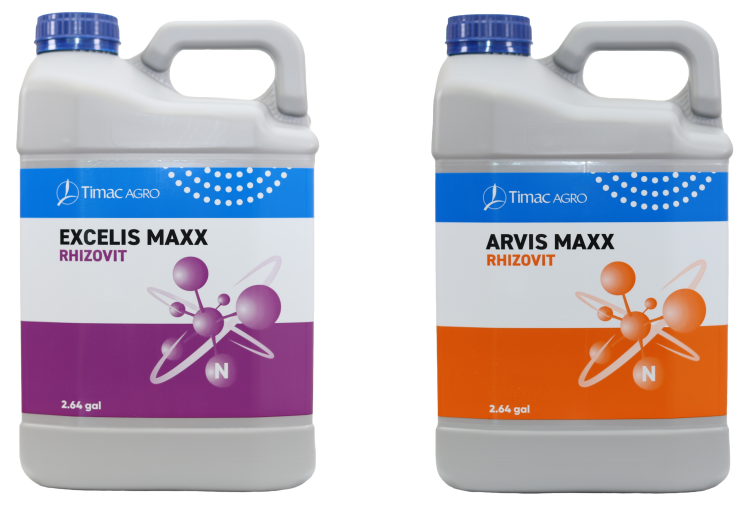
TIMAC AGRO USA’s EXCELIS MAXX® and ARVIS MAXX were engineered to do exactly that, delivering proven, multi-mode nitrogen protection for surface-applied urea and UAN across a broad range of crops and geographies.
Meet The Products: Above-Ground and Below-Ground Protection in Every Application
Both EXCELIS MAXX and ARVIS MAXX are built around the same foundational approach: protect nitrogen from loss in the air above the soil, and protect it from loss in the soil below, while supporting the biological environment that drives nutrient uptake.
The Core Technology: Three Modes of Action
Above-Ground Protection: NBPT [N-(n-butyl) thiophosphoric triamide]:
NBPT is a proven urease inhibitor that slows the enzymatic conversion of urea to ammonia, significantly reducing volatilization loss from the soil surface. By inhibiting urease activity, NBPT buys critical time keeping nitrogen in the plant-available urea form until conditions allow for proper incorporation or rainfall.
Below-Ground Protection: DCD (Dicyandiamide):
DCD is a nitrification inhibitor that slows the bacterial conversion of ammonium (NH₄⁺) to nitrate (NO₃⁻) in the soil profile. By keeping more nitrogen in the ammonium form, which binds to soil particles and stays in the root zone, DCD reduces the pool of nitrogen that is vulnerable to leaching and denitrification.
RHIZOVIT® Complex: The Biological Difference:
What sets both EXCELIS MAXX and ARVIS MAXX apart from standard NBPT+DCD stabilizers is the inclusion of the patented RHIZOVIT® Complex. Rhizovit activates beneficial rhizobacteria in the root zone, improving nitrogen uptake efficiency at the plant-root interface. Equally important, it helps buffer the negative biological effects that inhibitor chemistries can have on soil microbial communities, an issue that conventional stabilizers leave unaddressed.
Together, these three modes of action ensure that more of the nitrogen you apply gets into the plant protecting your investment above the ground, below the ground, and at the biology level.
EXCELIS MAXX vs ARVIS MAXX: Same Foundation, Different Fit
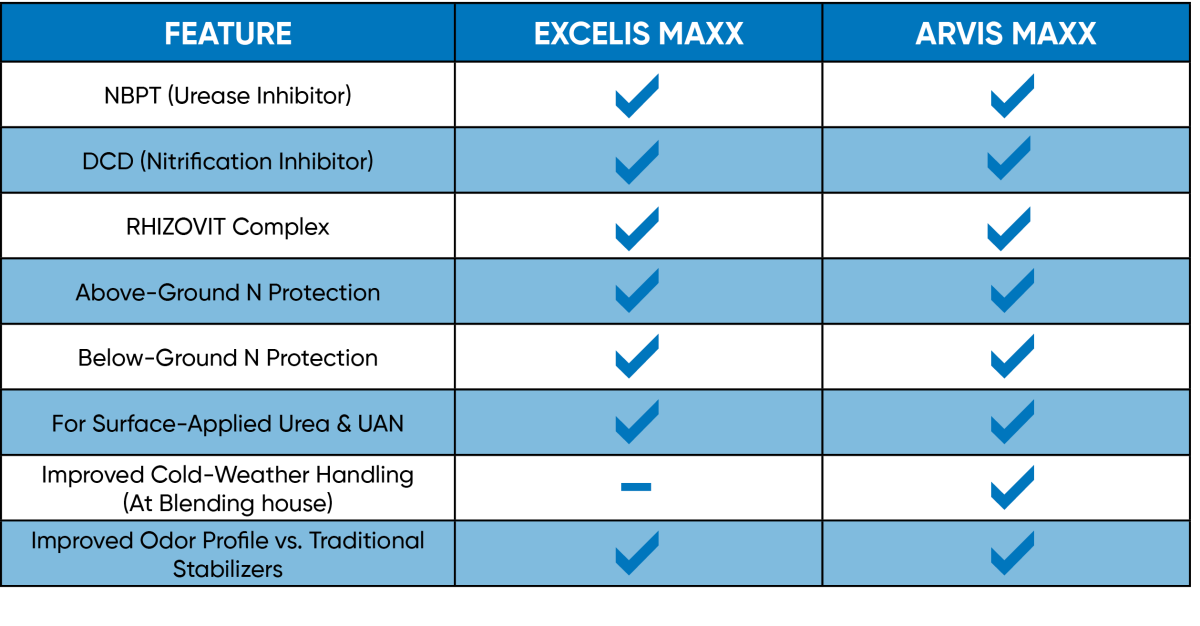
Both products deliver the same core active ingredient combination, NBPT, DCD, and Rhizovit®, which are formulated for the same application targets: surface-applied urea and UAN. The right choice between them comes down to the practical needs of the operation doing the treatment.
EXCELIS MAXX: The Proven Standard
EXCELIS MAXX is TIMAC AGRO USA’s flagship nitrogen stabilizer; a field-proven, industry-leading product built on a patented blend of inhibitors, penetrants, and antioxidants in a proprietary solvent system. It is the benchmark product for operations treating urea and UAN under standard conditions, with an extensive body of replicated trial data supporting its performance across corn, wheat, rice, and other major crops.
ARVIS MAXX: Built for the Blending House
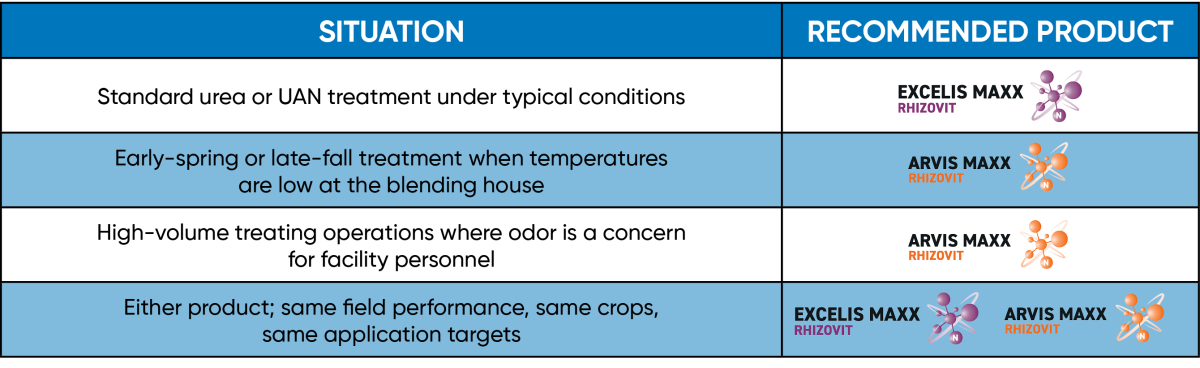
ARVIS MAXX delivers the same nitrogen protection as EXCELIS MAXX, but in a next-generation formulation with two practical advantages that matter specifically at the point of treatment.
Better Cold-Weather Handling: ARVIS MAXX uses a modified solvent system that maintains lower viscosity at reduced temperatures. For blending facilities treating urea in early spring or late fall, when ambient temperatures make conventional stabilizers thick and difficult to work with, ARVIS MAXX flows and applies more consistently, reducing application variability and equipment headaches at the blending house. This is a handling benefit at the point of treatment, not a field performance claim.
Improved Odor Profile: Traditional NBPT-based stabilizers are known for a strong, abrasive odor that can make the treatment process uncomfortable for facility personnel. Both EXCELIS MAXX and ARVIS MAXX are formulated to deliver a significantly more manageable odor profile than conventional materials improving the day-to-day handling and blending experience without compromising performance.
Both products protect nitrogen equally in the field. The differentiators are operational factors about who is doing the treating, where, and under what conditions.
Why Nutrient Use Efficiency is the Most Important Metric You're Not Tracking
Nutrient Use Efficiency (NUE) is defined as the amount of crop yield produced per unit of nutrient applied. It’s a measure of how much of your investment actually becomes grain, fiber, or biomass, and how much is simply lost to the environment.
Industry research consistently shows that conventional nitrogen fertilizers, applied without stabilization, can lose a significant portion of applied nitrogen to volatilization, leaching, and denitrification, depending on soil type, rainfall, temperature, and application method. The gap between what you apply and what your crop actually uses is where margin is made or lost.
EXCELIS MAXX and ARVIS MAXX are built on the premise that closing this gap is achievable, not through applying more fertilizer, but through protecting and activating the nitrogen you’re already paying for. The trial data supports this premise: treated fertilizer at reduced rates can match or exceed the yield performance of untreated fertilizer at full rates.
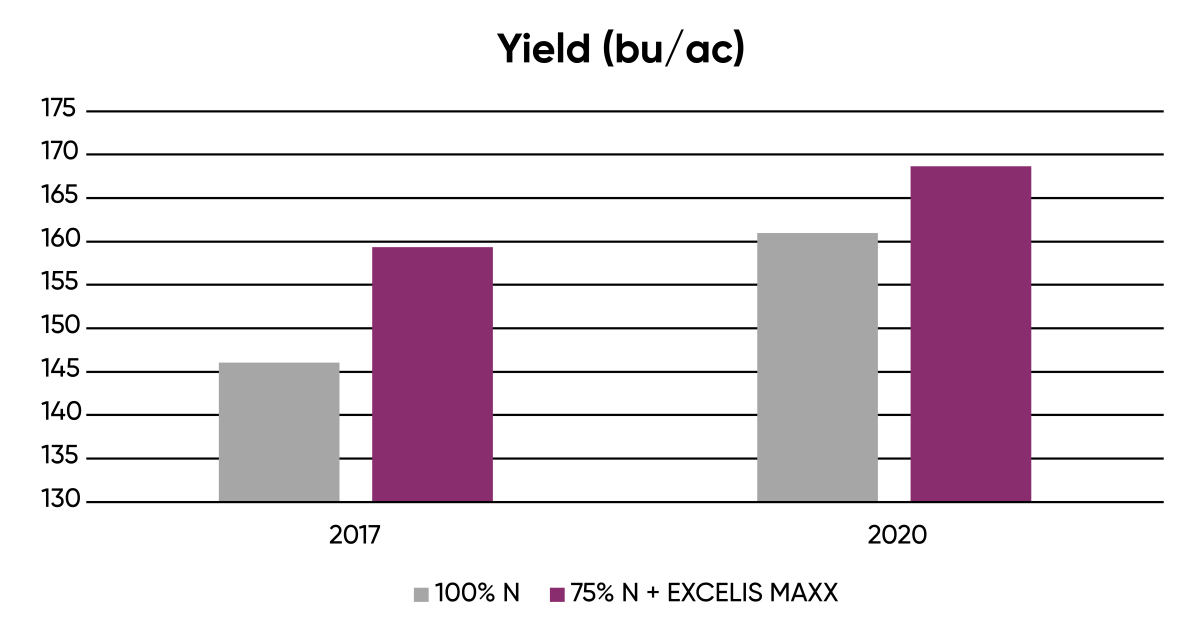
In a high-input cost environment, that’s not just agronomically sound, it’s economically essential.
What Product Is Right for Your Operation?
The right fit depends less on what’s happening in the field and more on what’s happening at the point of treatment. TIMAC AGRO USA’s technical team can help you evaluate which product makes the most sense for your specific operation and supply chain.
The Bottom Line: Protect What You've Already Paid For
You’ve invested in seed, land, and labor. Your nitrogen investment deserves the same level of protection. EXCELIS MAXX and ARVIS MAXX from TIMAC AGRO USA deliver three proven modes of nitrogen protection above-ground, below-ground, and biological in a single, easy-to-apply treatment for urea and UAN.
The technology is patented. The data is replicated. The results speak for themselves.
Ready to Put Science to Work in Your Fields?
Don’t let another season of nitrogen loss eat into your bottom line. Our team of agronomic experts is ready to help you evaluate which product fits your operation, review your current nitrogen management program, and build a solution that protects your investment and drives consistent results.